The Range Rover Sport Hybrid Test

Test Range Rover Sport Hybrid

The first British luxury-climbers, which also has an electric motor on board. The initial contact was added far more spectacular. The first kilometers in a Range Rover hybrid led the author at the wheel of a prototype - not destroyed by the earthquake - adventurous streets of Kathmandu in Nepal to Delhi in India.

Meanwhile, developed by Land Rover even diesel hybrid technology has arrived in everyday life and is also in the Range Rover Sport is available. And despite all the alleged Chaotik in domestic traffic flow, the driving experience can not compare this country with the on Indian roads. Although the use of one narrow garages spindle with the two meter wide Range Rover Sport is a challenge. After all, can this special graduate with a bit of luck in pure electric mode - to the amazement of other garage users who surprised the whispering giant.

Fortunately one of them, because the driver can not deliberately influence the charge status of the electric motor battery powering. When the system has operated too much in the garage on the electric-thrust from the entrance, just continues the V6 diesel. If the battery is just fully, it can be accessed by pressing the button for the pure electric mode. However, the system requires only very gentle foot on the accelerator and for a few hundred yards. If more propulsion demanded, the Nitro is back.

Test Range Rover Sport Hybrid

Behind this method. For the driver, the Range Rover Sport Hybrid simply provides more upbeat than the V6 diesel is not only that it reaches the acceleration values ​​of the V8 diesel, it also provides the same amount of torque available -. And starting at 1500 cycles. This results in an agility that you would not trust the nearly 2.4-ton colossus.

And with fuel consumption figures that could also hardly expect from a Range Rover in real life outside the norm consumption world. A practice-section of 8.8 liters of diesel in mixed operation is impressive in this league.

Not least because in hybrid Land Rover does not mean that you divide the drive of the two axes between Nitro and electric motor in order to arrive at an inexpensive all-wheel drive. Here you get the full package included the SUV expertise of the British. Whose qualities could be namely on the tangent not fathom, the Nepalese use but more so.

Test Range Rover Sport Hybrid

TECHNICAL SPECIFICATIONS
Range Rover 3.0 SDV6 Hybrid
Drive: V6, diesel, direct injection, 2x2 overhead camshafts, 24 valves, 2 turbochargers, all-wheel drive, 8-speed automatic;

Displacement: 29963 cm³
System Power: 340 hp
maximum torque: 700 Nm at 1500 r / min
Top 218 km / h, 0-100 in 8.9 sec; E-motor: 35 kW, maximum torque 170 Nm; Euro. 5

Chassis: Self-supporting body, aluminum sheet, subframe, front / rear independent suspension, front / rear wishbone, air suspension, electronic damper system, stabilizers, disc brakes (front / ventilated back inside), rack and pinion steering with electric power assistance, ABS, Brake Assist, Electronic Stability Program (ESP) ,

Dimensions (L x W x H): 4999 x 2073 x 1835 mm
Turning circle: 12.7 m wheelbase: 2922 mm cold braking distance: 40.7 m braking distance warm: 42.0 m

Trunk: 550-2030 l Weight: 2394 kg gross weight: 3100 kg Fuel tank capacity: 80 l
Normverbr .: 6,4 l / 100 km 169 g / km CO²
Testverbr .: 8,8 l / 100 km

Price: € 99,400 - Price test car: € 115,446 - Vehicle insurance tax: € 1,909.44

The Mercedes S-Class Hybrid

The Mercedes S-Class Hybrid

The Mercedes S-Class plug-in hybrid in the test as the plug-in hybrid drive could tempt comfortable user to a higher fuel consumption. Plug-in hybrids is predicted a bright future under the various hybrid versions. They promise electric driving in the city and the usual ranges overland. Mercedes plans to offer up to 2017 ten new models with plug-in hybrid drive. The first is the S-Class in long-wheelbase version.

The S500 plug-in hybrid was introduced in the autumn of last year, this year it was us as a test vehicle. It combines a V6 gasoline engine with an electric drive including 8.7 kWh lithium-ion battery (incidentally, the Magna-battery plant in Graz, which has since been sold to Samsung). As the low capacities suggests the electric range is according to standard consumption test only 33 km, in practice there are but 10 to 15 km away.

Porsche principle
Charging the lithium battery takes at the household power outlet 4 h, at the wall box 2 h. Many users, especially in this luxury segment, will probably be used the other way, namely the battery via the internal combustion engine while driving for emission-free trips in the city charge (takes about half an hour). The approximately two liters of consumption they will accept. Users assume quasi the principle of the first hybrid cars "Mixte" of Ferdinand Porsche. Its lead-acid batteries have been loaded via the internal combustion engine. However, Mercedes is working with the other German manufacturers also intensively on inductive charging.

The interplay between gasoline and electric drive worked anyway excellent. The quiet cruising with the big sedan is a class of its own. The S500 plug-in hybrid is the ideal long-distance sedan and proves thanks to the enormous power of the drive even large sporting qualities. Users can under four hybrid operating modes ("Hybrid", "E-Mode", "e-save", "batch") and three driving modes ("Hybrid", "E" as well as Economy "E +") choose. The selection is made by pressing a key.

The Mercedes S-Class Hybrid

The Wizard
Our test model was equipped among other things with Assist and Active Lane Keeping Assist, Head-up display (Projection of information in the windshield), panoramic sunroof, power-adjustable rear seats and leather interior, 360-degree camera, air conditioning in the rear. Since it was snowing again and again during the test date, the wizard refused their service and regularly reported "sensors contaminated". The reversing camera is also fixed on good weather. That this is the first plug-in hybrid from Mercedes in the S-Class, is also on the trunk, on the one hand can not be extended and on the other hand is characterized by a powerful stage at which the batteries are installed. Processing was awarded according to the price range. The guarantee for the plug-in components (including battery) is 6 years or 100,000 km away.

TECHNICAL SPECIFICATIONS
Mercedes S500 plug-in hybrid
Drive: plug-in hybrid drive with 6-cylinder petrol engine (2996) and electric motor. Lithium-ion battery with 8.7 kWh, 7G-TRONIC PLUS automatic transmission, rear-wheel drive.

Gasoline: 333 PS / 245 kW
E-Motor: 115 HP / 85 kW
Total output: 442 hp / 325 kWmaximales torque: 650 Nm
0-100 km / h in 5.2 seconds, top 250 km / h.

Chassis: Four-link front suspension, multi-link rear axle, front / rear air suspension, four ventilated disc brakes, ABS, Brake Assist, ESP stability system, electromechanical power steering rack. No trailer weight. Charging time 230 V / 8 A: 4.1 h, 400V / 16A: 2 h.

Dimensions (L x W x H): 5246 x 1899 x 1494 mm
Turning circle: 12.3 m wheelbase: 3165 mm hot braking distance: 35.2 m braking distance cold: 35.4 m

Trunk: 395 l Weight: 2215 kg gross weight: 2825 kg Fuel tank capacity: 70 l
Average fuel consumption: overall system 2.8 l / 100 km 65 g / km CO²
Test consumption: Hybrid mode 10.6 l / 100 km E-Range 33 Km (standard), 13 km (in the test / Winter)

Price: € 86,750 - Price test car: € 151,550 - Vehicle insurance tax: € 1,864

Mazda CX-3: All prices

Mazda CX-3: All prices

The new compact SUV will start with us in June. Mazda has the final prices and Features of the upcoming CX-3 for Austria announced. The compact SUV is positioning itself with 4.27 m length between Mazda2 and Mazda3 (at a height of 1.55 m). Optionally, the CX-3 is available with front- or all-wheel drive. On the engine side are two petrol engines (120 and 150 hp) and one diesel (105 hp) to choose from.

The CX-3 with 120-horsepower gasoline engine and with emotion equipment costs from € 17 990, -. The next best equipment (Challenge) is the Mazda from € 20 790, - to have, as attraction from € 22 790, - and a revolution from € 23 590, -. The attraction is also in conjunction with automatic available and costs from € 24 790, -.

The 150-horsepower gasoline engine is only available in Verbinung with wheel and comes with the revolutionary equipment to € 26,190, - (with automatic € 28 190, -). With the Revolution-top equipment, it would be from € 28 190, -.

The diesel costs as 2WD with manual transmission and Challenge Equipment from € 22,590, -, with Attraction equipment from € 24 590, - and a revolution from € 25 390, -. The all-wheel version available with revolutionary equipment from € 27 390, - (Revolution Top from € 29 390, -). Diesel in conjunction with all-wheel and automatic costs from € 29 390, - (as Revolution Top from € 31 390, -).

The equipment lines in detail: In the emotion include Front & Side & shoulder airbags, stability and traction control, radio + USB / AUX, 4 speakers, board computer, air conditioning and tire pressure monitoring system on board. '- Touch screen for onboard infotainment, CD radio, 6 speakers, cruise control, Bluetooth and 16' In Challenge City Emergency Brake Assist, Climate Control, HMI control (central rotary pushbutton controller), 7 'come' to aluminum wheels. The Attraction line features (based on the Challenge features) via LED headlights, -Tagfahrlicht, -Nebelscheinwerfer, rain and light sensor, tinted windows, lane control, parking sensors and heated seats. In the revolutionary head-up display, partial leather seats, reversing camera, keyless-go, and 18 '' aluminum wheels happen and the Revolution Top even white leather seats, Adaptive Headlights + High-Beam Assistant, Lane Change Assist, Adaptive Cruise Control + Brake Assistant and a BOSE sound system with 7 speakers. The navigation system is, as an extra for € 500 - available.

The SUV from Lamborghini comes in 2018

The SUV from Lamborghini comes in 2018
Lamborghini studie-urus 2012

The Italians have given the green light for the launch of a third series. Speculation about an upcoming SUV from Lamborghini, there has been quite some time, a study, the Urus, has already presented in 2012. Now you got the green light, which Lamborghini explained that for the realization of "the good cooperation of the Italian government, the VW Group, Audi AG (as Lamborghini shareholder), the Italian Ministry of Economic Development, the Italian agency for inward investment and economic development Invitalia, the Emilia Romagna Region and the unions was decisive. "

A corresponding agreement was signed on Wednesday by Lamborghini CEO Stephan Winkelmann and Italian Prime Minister Matteo Renzi in Rome. "We prove with this agreement that investment of quality for restarting the car sector is possible, which has suffered greatly in recent years under the crisis, now again entered a phase of recovery," Renzi said.

Building for the production of the SUV Lamborghini, the main factory in Sant'Agata Bolognese (Modena) from. The built-up area will almost double from the current 80,000 square meters to 150,000, at the same time create around 500 new jobs. The INVESTMENT is approximately EUR 800 million.

The SUV will be on sale from 2018, the main markets are the US, China, the Middle East, the UK, Germany and Russia. Lamborghini wants to sell of the third series annually about 3000 pieces. For comparison: in 2014 one has sold of Huracan and Aventador 2530 units.

About the technology and motorisation, the Italians have betrayed anything yet, but it is clear that the Lamborghini same basis as the other large SUV from the VW group (like Audi Q7 or Porsche Cayenne) will have. It is not the first SUV from Lamborghini. From 1981 to 1987, they have built with the LM 002 a brute-SUV with a V12 engine. A drive report from the new Lamborghini Aventador Superveloce read HERE.

Exclusive Lamborghini Aventador LP 750-4 Superveloce

Exclusive Lamborghini Aventador LP 750-4 Superveloce

This is about a car that will be on the market is no longer actually long. And, although it was presented only 3 months ago at the Geneva Motor Show. Why this? Well, Lamborghini has, following a tradition, held that the Aventador SV only a limited series of 600 will be built. That was when Miura SV so (385 pieces), the Diablo SV (492) and the Murcielago SV (670). And there stand at present already more than 500 Aventador SV were ordered, one can estimate that the "Sold Out" -Schildchen is already in preparation.

The name alone. SV stands for "Superveloce" and so a naming actually works only with the Italians. Would a marketing employee somewhere in Germany on the idea to give a car the suffix "Irsinnig quickly" to, the consequences would range from mockery and malice to the recommendation to mentally appropriately trained medical staff. But already "Quattroporte" sounds just melodic than "four-door" and if a thoroughbred Italian sports car "Superveloce" means the adrenaline already shooting a precaution.

A light Car & more
Especially when the thing stands in front of a bodily or almost crouching on the asphalt. 1136 mm low is the flounder, enter, or rather must be slipped over one wing doors. Pressing the hidden under a red cover start button and the V12 in the neck wakes up with a awe-inspiring roar. Shortly before one has yet explained to us why they do not put on but in normally aspirated turbo. The sound experience is one of the reasons (and that is so convincing that you otherwise must not say more). Otherwise one has us even stated that the Superveloce easier to 50 kg thanks to even more carbon than the normal Aventador that the aerodynamics have been improved so that more output is produced and that said V12 now generate about 50 hp more power - now makes a total of 750 hp. And again: That the Superveloce firstly is the fastest road car that has so far left the halls in Sant'Agata Bolognese and secondly that we should let the paws of that switch which disables the ESP.

The first exit Lamborghini gave us the Aventador LP 750-4 Superveloce, so is this thing with full name, on the GP circuit at Barcelona. This appears as the right turf for a car that accelerates in 2.8 seconds to 100 km / h 8.6 seconds 200 km / h is fast and the speed are Lamborghini with "more than 350 km / h" to. Superveloce halt.

Exclusive Lamborghini Aventador LP 750-4 Superveloce

More to achieve the performance, the engineers have increased the speed limit to 8500 / min. When approaching this limit can be experienced in the cockpit a Klangfurioso, simultaneously pushes the V12 that the numbers of digital speedometers jump so be expected to climb as those of the bathroom scales. The 7-speed dual clutch transmission sets the gears with lightning speed (where the awesome power of the engine the Lamborghini even accelerate, if you so excited on downshifting forgets). In Corse-mode, which is the sharpest setting, the gears are almost brutally smashed.

The cornering speeds are somewhere between stunning and sweaty and covered with Alcantara steering wheel and bucket seats give the necessary support (ie, they do their best). Speaking of steering. The Superveloce has a new dynamic steering, which operates with greater precision and less steering is required. As with the normal Aventador the force is transmitted to the road via four-wheel, up to 60% can be directed in an extreme case forward.

Exclusive Lamborghini Aventador LP 750-4 Superveloce

Rear wing
Hallmark of the Aventador is the big rear wing, which can be adjusted in three positions. And that - whether you believe it or not - by Phillips screwdriver. But an electrical adjustment could have put more weight and the customers like it quite, tell us the Lamborghini people. And when the driver needs to unpack the screwdriver in a car that costs this country just over half a million euros, which has already something comforting.

TECHNICAL SPECIFICATIONS
Lamborghini Aventador LP 750-4 Superveloce
Body and chassis
Monocoque carbon fiber monocoque with aluminum mounting frame
front and back
Body Engine cover made of carbon fiber, rear spoiler and side
Air intakes made from carbon fiber; Front bonnet,
Fenders and doors made of aluminum; rear fenders and
Side skirts cover from SMC
Suspension front and rear transverse magneto-rheological
Damper in pushrod construction
ESP ESP / ABS, characteristic selectable by Drive Select Mode
Brakes Hyraulische dual circuit braking system with vacuum
Power brakes, six-piston front calipers,
Four-piston rear calipers
Brake discs Carbon Ceramic Brake Discs,
Ø 400 x 38 mm - Ø 380 x 38 mm
Steering steering with three different Servotronic
Characteristics, combined with Lamborghini Dynamic Steering
(LDS), controlled by drive select mode
Tires Pirelli P0 Corsa, VA 255/35 ZR 20, HA 355/25 ZR 21
Wheels 9 '' J x 20 '' H2 ET 32.2 to 13 '' J x 21 '' H2 ET 66.7
Turning circle 12.5 m
Fixed rear spoiler manually adjustable in three stages
(High-medium-low downforce)
Airbags: two-stage driver's airbag and front passenger adaptive
Airbag, head-thorax airbags in the seats, knee airbags for
Driver and front passenger

Exclusive Lamborghini Aventador LP 750-4 Superveloce

Engine
Type V12, 60 °, MPI injection
Displacement 6498 cm3
Bore / Stroke 95.0 mm x 76.4 mm
Valve control inlet and exhaust continuously variable adjustment
Max. Power 750 hp (552 kW) at 8,400 rev / min
Max. Torque 690 Nm at 5,500 rev / min
Max. Engine speed of 8,500 rev / min
Power Weight 2.03 kg / hp
Emission class Euro 6 - LEV 2
Emission control catalysts with lambda control
Cooling system water and oil cooling system in the rear with variable air intakes
Motor Control Lamborghini Iniezione Elettronica LIE, with permanent ion current analysis
Dry sump lubrication
Drive Permanent all-wheel drive with Haldex clutch
Gearbox seven-speed ISR transmission, switching characteristics over Drive
Select Mode selectable
Standard Automated Manual Transmission
Clutch double-plate clutch, Ø 235 mm

Performance
Vmax over 350 km / h
0 - 100 km / h 2.8 s
0 - 200 km / h 8.6 s
0 - 300 km / h 24.0 s
100-0 km / h 30 m

Car Dimensions
Wheelbase 2700 mm
Length 4835 mm
Width 2030 mm (without mirrors)
Height 1136 mm
Front track of 1720mm, rear 1680 mm
Weight 1525 kg (dry)
Distribution 43% - 57%
Capacities
Fuel 90 liters
Engine oil 13 liters
Coolant 25 liters
Consumption (Dir. EC / 715/2007)
Urban 24.7 l / 100 km
Extra-urban 10.7 l / 100 km
The combined cycle 16.0 l / 100 km
CO2 emissions 370 g / km

Jaguar F-Type Acceleration

Jaguar F-Type Acceleration

The accelerated the Jaguar F-Type Coupé: Special Road of Pilgrims. It carries the honor and the burden of being the successor of what was voted "the most beautiful car ever made" by none other than Enzo Ferrari. F-Type Jaguar. Not exactly the car made to thrash records in Track Days or be unbeatable in the illegal start of traffic - he plays a very disinterested league in contention for the top of the podium or at the center of the spotlight, but at the same time, always magnetizing attention to your back. Were a person, you may well fall him the title of Steve McQueen of sports.

Released worldwide in April 2013, the F-Type carries in his little aluminum unibody more than two years of history - and we can already say that this will be a beautiful collectible in the future. The coupe version came at the end of that year and came to Brazil for exactly twelve months. What we have here, then, it is nothing new. But will you will care?

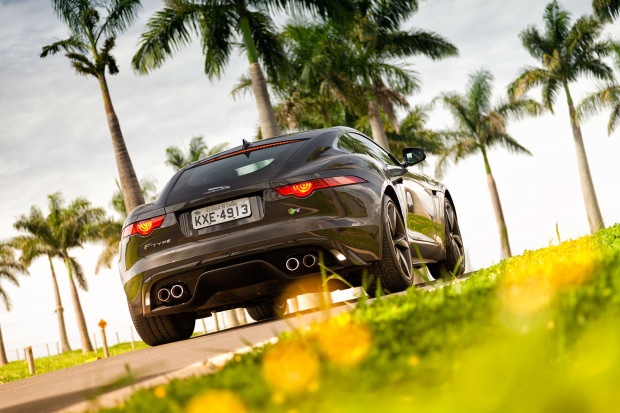
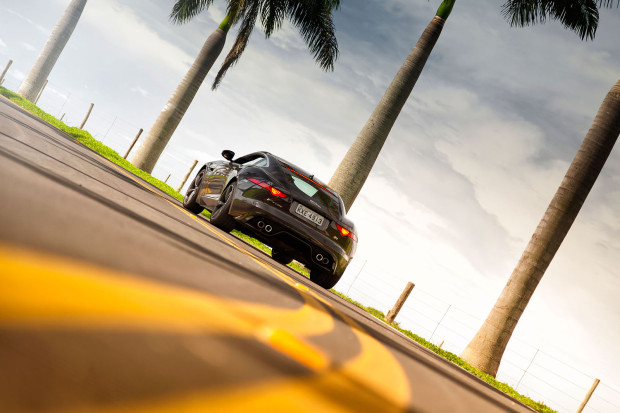
In the photos, made at the track Velo Città by Leo Sposito, show the Jaguar F-Type R Coupe, V8 5.0 of 550 hp and the onboard video below, we have an exciting ride with intermediate S V6 with 381 hp, the winding road the Pilgrims.

Yes, it's the second part (out of three) of our special on this route, and in it, walked the stretch between Pirapora do Bom Jesus and Cabreúva - click here to access the special with maps and geographic descriptions. Be sure to watch the video: in addition to the organic and visceral roar of the six-cylinder (do not miss the estralos the reductions!), You will find some technical details, comments on the dynamics and the explanation for my preference for intermediate front version to more powerful V8.

Jaguar F-Type Acceleration

The Jaguar F-Type is basically a big party of aluminum. The material composing the engine block and cylinder heads, suspension arms (double in the front and rear) and the front frame and especially almost all panels and the monocoque vehicle - have the strongest manufactured by Jaguar with torsional stiffness of 33,000 nm / degree - composed of riveted stamped aluminum sheets and joined by industrial glue, a process that better distributes the structural tensions. About 90 meters adhesives and exactly 2,225 rivets are used in this process in the F-Type Coupé. Already columns, girders and structural beams using components manufactured by extrusion and hydroforming.

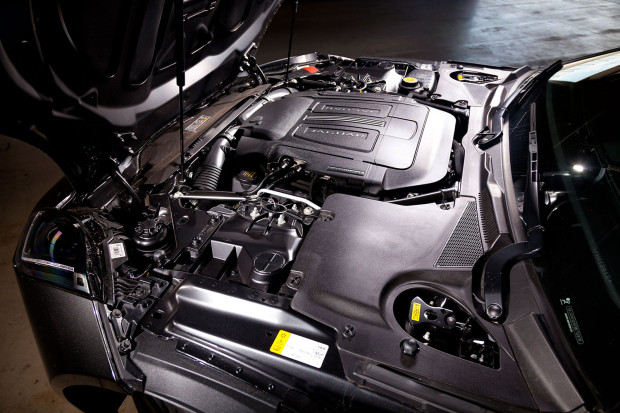
The sides and the F-Type hood are composed of a single sheet of aluminum that passes through five stages of stamping in a press of 1,000 tons. Since the back cover is plastic composite material. Their power plants as well as the unibody construction technology, are shared with Land Rover: the engines are the 3.0 V6 and V8 5.0, both with twin screw type compressor (like the Corvette ZR1), direct injection and commands variables. There are three versions of Jaguar F-Type Coupe available in Brazil: V6, V6 S and V8 R, all with the eight-speed automatic transmission ZF 8HP - remembering that the F-Type manual and all-wheel drive was launched just outside and should reach the country in the coming months. See the main figures of the trio:

F-Type V6 (R $ 426,300): 340 hp at 6,500 rpm, 45.8 mkgf to 3,500 rpm, 1577 kg, rims 18. Zero to 100 km / h in 5.3 s, maximum 260 km / h. Brake discs: 354 mm and 325 mm. System open differential.

F-Type V6 S (R $ 497,700): 381 hp at 6,500 rpm, 46.9 mkgf to 3,500 rpm, 1594 kg, rims 19. Zero to 100 km / h in 4.9 s, maximum 275 km / h . Brake discs: 380 mm and 325 mm. Mechanical limited slip differential system.

F-Type V8 R (R $ 662,000): 550 hp at 6,500 rpm, 69.3 mkgf at 2,500 rpm, 1650 kg, rims 20. Zero to 100 km / h in 4.2 s, maximum 300 km / h . Brake discs: 380 mm and 376 mm. System locking differential electronically activated.

Dimensions: 4.47 m long, 1.92 m wide, 1.30 m high, wheelbase of 2.62 m, Pirelli P-Zero 255/35 R20 and 295/30 R20 (F-Type V8 R).

If the buyer wants, there is the option of carbon-ceramic discs for both the V6 to V8 S and R, with rotors of 398 mm front and 380 mm at the rear is 21kg lighter than the original shown above. Both versions also come as adaptive dampers differentials and dampers with active valve (optional on standard V6), which allow the driver to choose between a more restrained and smooth snoring and another harsher, with the right estralos and pipocos in reductions march, remembering the days of carbureted racing cars burning the rest of the mixture escapes. Here, the magic is made in the design of resonant chambers. In addition, Jaguar offers a number of personalization options, such as items in carbon fiber (mirror cover, engine cover, hood louvers, front splitter and rear diffuser), alloy wheels with other designs, exhaust tailpipes differentiated, stainless steel pedals, customizable sills, steering wheel in suede and sports (flat base), premium and sports carpets and covers.
Jaguar F-Type Acceleration

To unlock the vehicle, the recessed external door handles protrude out and let in. Once it enters the cabin, looks are naturally directed toward the diagonal bar that triangulates the panel to the center console. And it leaves a clear message: passenger, do not disturb - this is a machine pilot service.

A fragrant smooth and soft leather quality first, worthy of a Range Rover Sport - enlarge the photo to taste - lining the banks, the doors, the dashboard and even around the center console. Heatable, banks not only have a hell of lateral support as they have huge range of adjustments, complete with electro-pneumatic adjustments of side bolsters and lumbar support, plus three memories for both the driver and for the passenger.

If banks adjustments buttons, positioned in the doors, resemble the arrangement of Mercedes-Benz, the shift lever type joystick resembles the BMW, including in terms of ergonomics: the "P" button on the top of the lever and selection the other positions by unlocking via trigger type button.

Around the engine start button there is a light ring that pulsates like a heart before you turn on the V8 (or V6) - and when you do, apart from the engine roar, the vents on top of the panel are rising panel. The exchange side is the Dynamic mode selector, which leaves more sporty mappings of the accelerator, the shift and stability control, and adaptive dampers stiffen and the load direction. The steering system is traditional, hydraulic, according to Jaguar so there are no filters or emulations between the hands of the rider and the asphalt. The box has variable ratio and average of 14.6: 1, the fastest ever used by the brand.

Jaguar F-Type Acceleration

Shifting lever are behind the hand brake actuation and a Quatrilho buttons: disable part or all the stability control, drive the sport mode of the dampers, turn off the start-stop system and raise the rear wing - which automatically occurs in excess of 100 km / h speeds.

The occupants have an automatic air conditioning system dual zone type and the entertainment system has 8 "screen touchscreen browser type and GPS, plus some interesting functions such as power meter G, timer and individual customizer of dynamic programming (exchange, accelerator, steering and shock absorbers).

The riding ergonomics follows a more class than performance income - the main argument seems to be "solid", not "agility". Therefore, the panel goes quite deep, the steering wheel rim is quite thick and its generous diameter (for sports) is comparable to that of Mercedes-Benz AMG. The brake pedal also resembles that of the AMG, or ideally would be slightly more rigid. But as you saw in the video, it has everything to do with the proposal of the F-Type.
Jaguar F-Type Acceleration

Throw away the clock - in fact, this Jag even have launch control - track comparative, obsession with perfection and Trump Super games with fact sheets: here is a esportivaço for you to enjoy in long highways and winding road mountain, a Total played gentleman driver with serious sportiness and pepper, but without extremes. In the first controlled skid to do with the prelude of the exhaust estralos the reductions, you will take the plunge: the experience is all that matters. Technically the Jaguar F-Type competes with the Porsche Boxster and Cayman, but in practice we are talking about very different profiles of buyers.

If what you want is to live the experience and the flavors of a coupe vivid, passionate, organic, with visual elegance comparable to Aston Martin and comfort Shooting enough to run in the Brazilian asphalt without leaving with a herniated disc, welcome to the world Jaguar F-Type.
Jaguar F-Type Acceleration

Which version pick? I have not the slightest doubt that the V6 S, over R $ 160,000 more into account that the V8 R, is the best choice. I do not talk about value for money, but about sensory experience and played. The nasal and metallic roar of the six-cylinder has more historical context that the muscle car roar of the big eight, that sounds perhaps a little too similar to the AMG sports or the Mustang GT500. Moreover, in the context of a racetrack or a hillclimb the V8 has torque too much for the dynamic assembly of the F-Type (we're not talking about controlled skids, but of violent rabeadas) and even for the powertrain - the ZF 8HP is clearly uncomfortable with nearly 70 mkgf, especially in exchanges made close to the cutting working.

The perfect F-Type, for me, it would be this: S V6, with kit of aftermarket pulleys (already out there, yielding somewhere around 30 hp extra) to the compressor, a set of tires R-compound Yokohama Advan Neova and optional carbon-ceramic brake. British Racing Green, please. And manual transmission, thank god. [Photos: Leo Sposito]

Legitimate Ford Mustang Classic Drag

ford mustang custom

Big block 7.0 and 600 hp: this legitimate Ford drag classic Mustang is the last of its kind. Every fan of muscle cars know that the golden age for these cars were the 60s Imagine US streets full of cheap coupes, beautiful and equipped with powerful, noisy V8 engines. Paradise, is not it? And competition among manufacturers was fierce, with Detroit's Big Three - Ford, General Motors and Chrysler - running for slapping the preference of enthusiasts. One of the biggest weapons to achieve good sales were drag racing: the fastest car on the quarter-mile became the most wanted by the public. Win on Sunday, sell on Monday.

Therefore, the manufacturers did not spare efforts to make their models were the fastest on the dragstrip, investing money in preparing the engines and creating true squadrons of mechanics and pilots to win the championships organized by the NHRA, the National Hot Rod Association. Ford division even had a name: Drag Council, or "Council of Drag Race". Their mission? Defeat the rivals in the category A / FX, in which competed the stupidest car in the best sense of the word.

ford mustang custom

For this, Ford delivered the cars Detroit Steel Tubing, Dearborn company that supplied raw materials to the manufacturing for years. One of his first creations was the Ford Fairlane Thunderbolt, 1964, which we have shown here.

That year, however, the Mustang was released. Ford had bet all the chips in the new model, which had the proposal to be a cheap sport, powerful and youthful appeal. Qualities to this he had, as we know very well today. However, 50 years ago he was still just a promise and, as such, had yet to show their full potential on the slopes.

ford mustang custom

So in 1965 the Ford ordered a new batch of cars to the drag Council - this time, a fleet of ten Mustang. And this time, the modifications to rush be borne by the Holman Moody team made famous in the 50s for being responsible for cars that Ford put to race in NASCAR.

There is no consensus regarding the amount of cars that have been produced - it was 10 or 11 - but it is known that only five of them survived to the present day. One was auctioned today (6) by Mecum Auctions (the same as recently auctioned one of Toyota Supra used in the first "Fast and the Furious") at an event in Seattle, in Washington State, USA.

ford mustang custom

Notice anything different about him? Well: the wheelbase has been shortened by a few centimeters to improve the weight transfer in the rush hour and thus assist in traction. It is believed that this is the only car to preserve this characteristic - the others had to modify revert to adapt to the NHRA rules for 1966. However, this was not the only change in the car.

For starters, the engine was the 427 V8 SOHC "Cammer" a big block of seven liters which, as we have here, has been specially created to compete against the 426 Chrysler Hemi in Nascar and delivered somewhere between 500 and 600 hp. To accommodate the new engine, the wheel housings were cut and the original suspension system was replaced by a beam semielípticas springs. Furthermore, fenders, hoods and doors were glass fiber, while all glasses (with the exception of the windshield) was replaced by polycarbonate to reduce weight. The interior (which was all upholstered in black vinyl) lost the rear seat, but surprisingly their appearance was largely original - and looks even comfortable, tell yourself.

ford mustang custom

According to the Mecum, the auctioned car competed in 1966 with pilot Bob Hamilton behind the wheel. At some point in its history (it is believed that in 1967), the car had two quad carburetors body replaced by a Hilborn injection system. Years later, the Mustang underwent a restoration work that, according to Mecum, left the car exactly as it was when he competed, including the original magnesium wheels shod with tires ripped season. The plot even includes a certificate of authenticity signed by the Bob Hamilton and Lee Holman, H & M.

According to the Hemmings.com, the Mustang Long Gone appeared for sale for the last time in 2011, on eBay, priced at $ 765,000 (about US $ 2.4 million in direct conversion). The Mecum estimated one finish of between $ 500,000 and $ 700,000 (somewhere between £ 1.5 million and £ 2.2 million). A visit to the site of the guys reveals, however, that the car was not fetch. In other words, if you have $ 2 million giving soup, there is still a chance to buy a legitimate Mustang torn 60s.

Create a Monster, this guy put a V8 1,000 hp LSX in a Willys Jeep '50s


You may have seen a Jeep Willys there. Sure you've seen - the utilities with military roots is has been produced for 42 years, 1944 and 1986, and are among the most famous and popular off-road vehicles on the planet, and were also manufactured in Brazil by Willys and then by Ford, between 1954 and 1983. They are frugal and heavy duty vehicles, have a nice look and therefore are widely used trails and recreation today. And they do not need much power for this: in Brazil, for example, the Willys Jeep factory came with a six-in-line 2.6-liter 90 hp (although some prefer to install it the four-cylinder 2.5 the Chevrolet Opala or even good old Volkswagen AP).

Now, go tell the owner of this Jeep that he put too much power in his Jeep! His name is Justin Miller, he lives in Washington, Missouri, USA, and his Jeep Willys CJ-3A in 1953 now shows, proud, a V8 Chevrolet LS family. Are 4.8 liters and, thanks to a kit of nitrous oxide and neat preparation, the power reaches 1,000 hp. MIL HORSES. In a roofless Jeep, doors, airbags or even seat belts and weighing less than 900 kg. This guy is crazy.


So crazy, in fact, that we take a look at your creation more closely. But first, how about seeing the Jeep massacring a Corvette ZR-1, a Porsche Cayman and a Honda CB600 in drag?

Justin had to spend a few years convincing the owner of this Jeep, his neighbor, to sell it - he saw the CJ in the garage, in need of care, and had the dream of restoring it. In 2011 he was able to buy the Jeep and, six months later, he began what would be only a restoration process. Having served the US military for a few years and retired for health reasons, Justin wanted to pay tribute to the period of military service - nothing more appropriate, since the very Jeep appeared as a military vehicle and was only turned into a civilian vehicle after the Allies won World War II.


Thus, the Jeep logo was painted in the typical green of military vehicles and was decorated with war themes, such as ammunition boxes in the trunk and typography in stencil. Everyone knows that this visual fits like a glove in the Jeep, right? It did not take, however, that Justin realized that the original engine Jeep was too weak (being an American model 1953, probably it was the four-cylinder "Go Devil" of Willys, 2.2 liter and only 48 hp ). Then, jokingly, Justin told a friend that put a V8 LS in his Jeep.

Now ... if the idea is in the air, why leave all a joke? The V8 LS GM engines are not exactly difícieis to find in the US - just the opposite, actually. Thus, in 2013 the Willys already had the 4.8-liter V8 originally used in pickups and utilities like the Chevrolet Express and GMC Sierra. At the time the engine gave "only" 300 hp, which was enough to ensure a lot of fun, as shown in the video below:


Since then, Justin held some important modifications to the engine, being the main one was installing a mechanical compressor ProCharger operating at 1.1 bar pressure. Combined with a new system of injection and an edgier valve timing, the compressor has raised the horsepower to about 730 horsepower and 92.5 mkgf torque at the wheels. In addition, the engine earned a kit with two cylinders of nitrous oxide (suitably painted military green and exposed in the back, for everyone to see) that, when it comes into action, help to produce more than 300 hp. Do the math!

The exchange is the 480Le Chevrolet, four-speed automatic coupled to a torque converter Monster 3200 and Richmond differential with final drive ratio of 3.73: 1. The wheels are shod by a set of tires Mickey Thompson ET, while the suspension for rigid axles is completely stock, which is a beautiful demonstration of insanity.


Since then Justin's Jeep was relatively famous in the tuning community in the region, a presence at events like the SEMA Show last year. With a look so great a power-to-weight ratio of less than 1 kg / hp when nitro is activated and several videos around the internet, it is not hard to understand why.
Photos: GConnoyer Photography

Renault Kwid: The mini-SUV in India

The mini-SUV Renault Kwid

The mini-SUV Renault Kwid has now presented in its actual form. From the exciting study of the previous year a sober production model for use on India's roads has become challenging. At the Auto Show in Delhi last year he was one of the big surprises. The mini-SUV Renault Kwid was as yet been as exciting study with thick knobby tires, wing doors and extravagant solutions for Interior Color as an eye catcher on the Renault stand. Renault design chief Laurens van den Acker then on international cooperation in the origination of the study on the courier: "The exterior comes from our studio in Brazil, the interior and the color choice as submitted by our two Indian studios in Mumbai and Chennai."

Now Renault is the first time that model of the same name, which emerged from the study, and in India in the autumn will come on the market. As might be expected, the extravagant solutions the study a practical and robust form have given way to that is to make the Renault Kwid for serious players in the booming in the Indian car market segment of mini-SUV. These are not least because so much in demand, because cars are 4 meters external length favorable tax in India and the greatest utility among buyers is on the requirement profile at the top.

Under four meters
With only 3.68 m long and 1.58 m wide, the Renault Kwid fits into this market segment, in which some of the already celebrated successes with us available Ford Ecosport. This is particularly highlighted by Renault equipping the Kwid with a multimedia navigation system with a central 7-inch color monitor, a novelty in this vehicle class in the Indian market. As engine a new 0.8-liter petrol engine is used on its performance can still be weigt.

Unlike Ford, which is used with the originally designed for Brazil Ecosport after the success in India and in Europe, there is at the moment no such plans Renault. In India, Renault Kwid to cost the equivalent of 4000-5500 euros.

Porsche 911 GT3 RS

Porsche 911 GT3 RS

Porsche 911 GT3 RS: The Dinner is served. The sharpest version of the Porsche 911 is in the starting blocks, the new GT3 RS is the fifth generation of the road-going circuit racing athlete. In order to assess his specific skills in the Porsche universe is correct, is a special lap time. With the 7 minutes 20 seconds, the new Porsche 911 GT3 RS needs for a round at the Nürburgring Stadium, it is by almost 9 seconds faster than the former super sports car Carrera GT.

This performance is achieved through a package of measures on the engine, transmission and chassis. So does the now largest-displacement (4.0 liter) and most powerful naturally aspirated engine with direct injection in the 911 universe whopping 500 hp and has a maximum torque of 460 Nm.

Lightweight Car
More Power meets the 911 GT3 RS but also on less weight. Thus, there is about the vehicle roof made of magnesium and motor such as trunk lids and fenders are made of carbon fiber. Despite the over the 911 Turbo once again widened rear That brings a weight saving of 10 kg compared to the normal 911 GT3. Taken together, this combination breath (BE) consuming acceleration gives 3.3 seconds for the sprint from zero to 100 km / h in just 10.9 seconds speed 200 is reached.

The Hot Rod City Tour

The Hot Rod City Tour

The Hot Rod City tour starts later this month in Vienna now. In 13 European cities have them already, the little soapbox racer, with which you can take a guided tour. Now also gets a Vienna Hot Rod City Tour. The single-seater is powered by a four-stroke engine with 170ccm and 14 hp, the vehicle can be driven by anyone who is in possession of a valid B driving license. The manufactured in Hamburg at the manufactory Wenckstern cars reach a top speed of 88km / h (although for the local area's anyway not relevant).

The Hot Rod City Tour Vienna leads from the garage at Schwedenplatz in the immediate vicinity of the rental office in the Judengasse 4 - opening times daily from 10.00 to 19.00 clock - around the Vienna City including detour to Ferris wheel / Prater and Uno-City beyond the realm bridge. Pro Tour are twelve vehicles available, where the hot rod armada led by a guide and completed by another guide, therefore not a participant is lost. 

When rain and bad weather, the Hot Rods have clearly break, and even in winter the runabout remain with its distinctive snout in the garage. Otherwise, find every day at 10.00 clock, 13.00 clock 16.00 clock and 19.00 clock tours instead, the Moonlight Tour starts at 20.30 clock going. A tour takes 120 minutes, the ticket for the classic tour costs € 99th

"Safety is at Hot Rod City Tour Vienna writ large", as Florian Matthies, who has the Hot Rod City Tour exclusively brought to Vienna, explains. The originating from Hamburg dial Wiener is the founder and owner of Hot Rod City Tour Vienna: "Each participant must wear a safety helmet, including balaclava. And of course, applies to us, without exception, the 0.0 alcohol limit. " Info source; kurier.at